Getting On Track: Better Management Through Basic Ag Records

Graphic of RightRisk Media Post

 
Getting On Track: Better Management Through Basic Ag Records is a two-hour, internet-based course including four vignettes titled: Preserving The Tradition, Putting All Your Eggs in One Basket Get the Max From Your Tax, and 4-H Gone Hog Wild. Other topics covered include: Why keep records?, Basic record keeping 5 easy steps, Keeping production records, Keeping financial records, Schedule-F, Where do I go from here? A glossary, frequently asked questions, and resource links are provided, along with example records systems and much more…

The Basic Ag Records course is available free of charge at RightRisk.org > Courses.
Limited Liability Company

Graphic of RightRisk Media Post

 
Limited Liability Companies (LLC) are a creature of statute, recognized in each jurisdiction only by virtue of a legislative enactment in each state. There are three aspects of the LLC that are enticing for new businesses: (1) it can be taxed as a partnership, as a corporation (if such an election is granted by the I.R.S.), or as a disregarded entity if there is only a single member; (2) it is an extremely flexible form of business both in terms of options when creating the business and options about how it is to operate; and (3) it offers all members limited liability.

Learn more via the recently completed 4-page, 4-color RISK CONCEPTS series, covering seven common forms of business ownership, including Limited Liability Companies.

Several RISK CONCEPTS bulletins covering alternative forms of business structure were recently posted and are available for download at: RightRisk.org/riskconcepts.

USDA Announces Improvements to Livestock Risk Protection

Graphic of RightRisk Newsrelsease

 
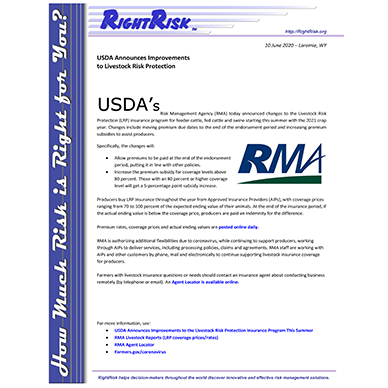
USDA’s Risk Management Agency (RMA) today announced changes to the Livestock Risk Protection (LRP) insurance program for feeder cattle, fed cattle and swine starting this summer with the 2021 crop year. Changes include moving premium due dates to the end of the endorsement period and increasing premium subsidies to assist producers.

Click here to learn more…

Enterprise Risk Analysis

Graphic of RightRisk Media Post

 
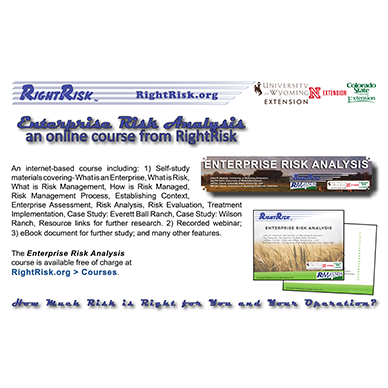
Enterprise Risk Analysis is an internet-based course including: 1) Self-study materials covering- What is an Enterprise, What is Risk, What is Risk Management, How is Risk Managed, Risk Management Process, Establishing Context, Enterprise Assessment, Risk Analysis, Risk Evaluation, Treatment Implementation, Case Study: Everett Ball Ranch, Case Study: Wilson Ranch, Resource links for further research. 2) Recorded webinar; 3) eBook document for further study; and many other features.

The Enterprise Risk Analysis course is available free of charge at RightRisk.org > Courses.
Sole Proprietorship

Graphic of RightRisk Media Post

 
The Sole Proprietorship is the simplest business form under which one can operate a business. The sole proprietorship is not a legal entity. It simply refers to a person who owns the business and is personally responsible for its debts. A sole proprietorship can operate under the name of its owner or it can do business under a fictitious name.

Learn more via the recently completed 4-page, 4-color RISK CONCEPTS series, covering seven common forms of business ownership, including the Sole Proprietorship.

Several RISK CONCEPTS bulletins covering alternative forms of business structure were recently posted and are available for download at: RightRisk.org/riskconcepts.

Risk Scenario Planning

Graphic of RightRisk Media Post

 
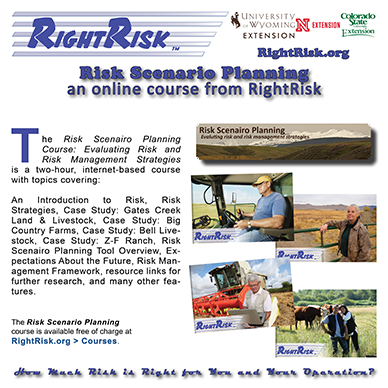
Risk Scenario Planning: Evaluating Risk and Risk Management Strategies is a two-hour, internet-based course with topics covering: An Introduction to Risk, Risk Strategies, Case Study: Gates Creek Land & Livestock, Case Study: Big Country Farms, Case Study: Bell Livestock, Case Study: Z-F Ranch, Risk Scenario Planning Tool Overview, Expectations About the Future, Risk Management Framework, resource links for further research, and many other features.

The Risk Scenario Planning course is available free of charge at RightRisk.org > Courses.
What are the U.S. Regulations for Child Labor in Agriculture?

Graphic of RightRisk Media Post

 
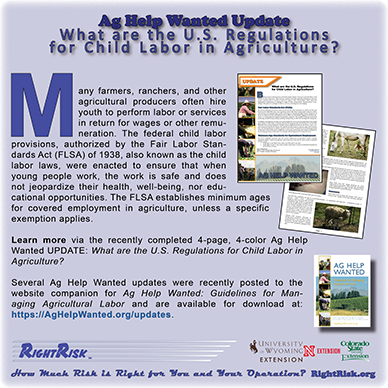
MANY farmers, ranchers, and other agricultural producers often hire youth to perform labor or services in return for wages or other remuneration. The federal child labor provisions, authorized by the Fair Labor Standards Act (FLSA) of 1938, also known as the child labor laws, were enacted to ensure that when young people work, the work is safe and does not jeopardize their health, well-being, nor educational opportunities. The FLSA establishes minimum ages for covered employment in agriculture, unless a specific exemption applies.

Learn more via the recently completed 4-page, 4-color Ag Help Wanted UPDATE: What are the U.S. Regulations for Child Labor in Agriculture?

Several Ag Help Wanted updates were recently posted to the website companion for Ag Help Wanted: Guidelines for Managing Agricultural Labor and are available for download at: AgHelpWanted.org/updates.

Understanding Risk In Agriculture

Graphic of RightRisk Media Post

 
Understanding Risk in Agriculture is an internet-based module including: 1) Self-study materials covering- What is risk, Does Risk Matter, Can Risk be Managed, What Are Challenges to Managing Risk, When is Risk Analysis Justified, How are Risky Choices Evaluated, How is Risk Included When Making a Decision, and Conclusion. 2) Recorded webinar- Posted presentation slides, Posted Introduction, Posted URIA – the first four segments, Posted URIA – the last three segments, Posted Q&A session; all in video and audio-only formats; 3) eBook document for further study; and many other features.

The Understanding Risk In Agriculture module is available free of charge at RightRisk.org > Courses.