- What is a Personal Representative?
- Applied Risk Analytics
To subscribe/unsubscribe, send email to information@RightRisk.org with subject line “Subscribe/Unsubscribe RightRisk News”
To subscribe/unsubscribe, send email to information@RightRisk.org with subject line “Subscribe/Unsubscribe RightRisk News”
To subscribe/unsubscribe, send email to information@RightRisk.org with subject line “Subscribe/Unsubscribe RightRisk News”
Expansion Crop insurance coverage is available for 15 individual crops or crop groups in Wyoming. However, for several crops federally-subsidized insurance coverage is only available in a limited number of counties.
An insurance product that may be of interest to beginning farmers and ranchers and producers of small acreages of multiple high-value crops is the Whole-Farm Revenue Protection Policy (WFRP). This pilot policy has been available to producers in all Wyoming counties in recent years.
This policy paper provides a description of the Whole-Farm Revenue Protection Policy and illustrates the application of WFRP to an example Park County irrigated farm.
Federal crop insurance products have been available to farmers in the United States for 80 years. Beginning in the early 1990s, the range of products offered by the USDA Risk Management Agency expanded, and today farmers have access to federal crop insurance for most of the crops they grow. Currently, nationally farmers can obtain insurance for over 140 crops and forages. Over the past several years, coverage has become widely available for crops produced under organic practices at price elections based on prices that reflect organic premiums.
Wyoming farmers, especially new and beginning farmers, need to understand these features and the information they will need to obtain federal crop insurance coverage.
“An Introduction to Federal Crop Insurance Products for New and Beginning Wyoming Farmers and Ranchers,” covers the following topics for crop and livestock operators in Wyoming:
1. An overview of which types of crop insurance are currently purchased by Wyoming farmers;
2. A decision criteria farmers may want to use in making their decisions about crop insurance;
3. The “units” issues farmers must address in determining whether or not to insure crops on the farm under a single APH contract or multiple contracts;
4. The process for establishing actual production histories on each insured unit;
5. Yield and revenue insurance options, with examples of how a producer’s premium costs, premium subsidies and indemnities may differ under yield and revenue insurance;
6. Other insurance options for crops, including GRP and whole farm insurance products;
7. Options that may be available to manage risk for crops not covered by federal crop insurance in a county; and
8. Insurance options applicable to livestock producers available through RMA, including the Pasture, Rangeland Forage (PRF) vegetation index product.

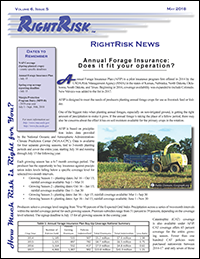
One of the primary strategies for managing risk is transferring risk outside the farm or ranch through insurance products or other mechanisms. Crop insurance dates back to the 1930s in the U.S. However, under those programs, there have not been many insurance options available to forage producers. That has changed considerably in recent years. This article provides a brief summary of the options currently available offering protection to forage producers.
…. click here to read more.
Bought to you by:
Progressive Forage
and The RightRisk Team
To subscribe/unsubscribe, send email to information@RightRisk.org with subject line “Subscribe/Unsubscribe RightRisk News”
To subscribe/unsubscribe, send email to information@RightRisk.org with subject line “Subscribe/Unsubscribe RightRisk News”