- Forage Risk Analysis Tool helps evaluate lease agreements
- The Worker Protection Standard – 2017 Compliances

To subscribe/unsubscribe, send email to information@RightRisk.org with subject line “Subscribe/Unsubscribe RightRisk News”

To subscribe/unsubscribe, send email to information@RightRisk.org with subject line “Subscribe/Unsubscribe RightRisk News”
To subscribe/unsubscribe, send email to information@RightRisk.org with subject line “Subscribe/Unsubscribe RightRisk News”
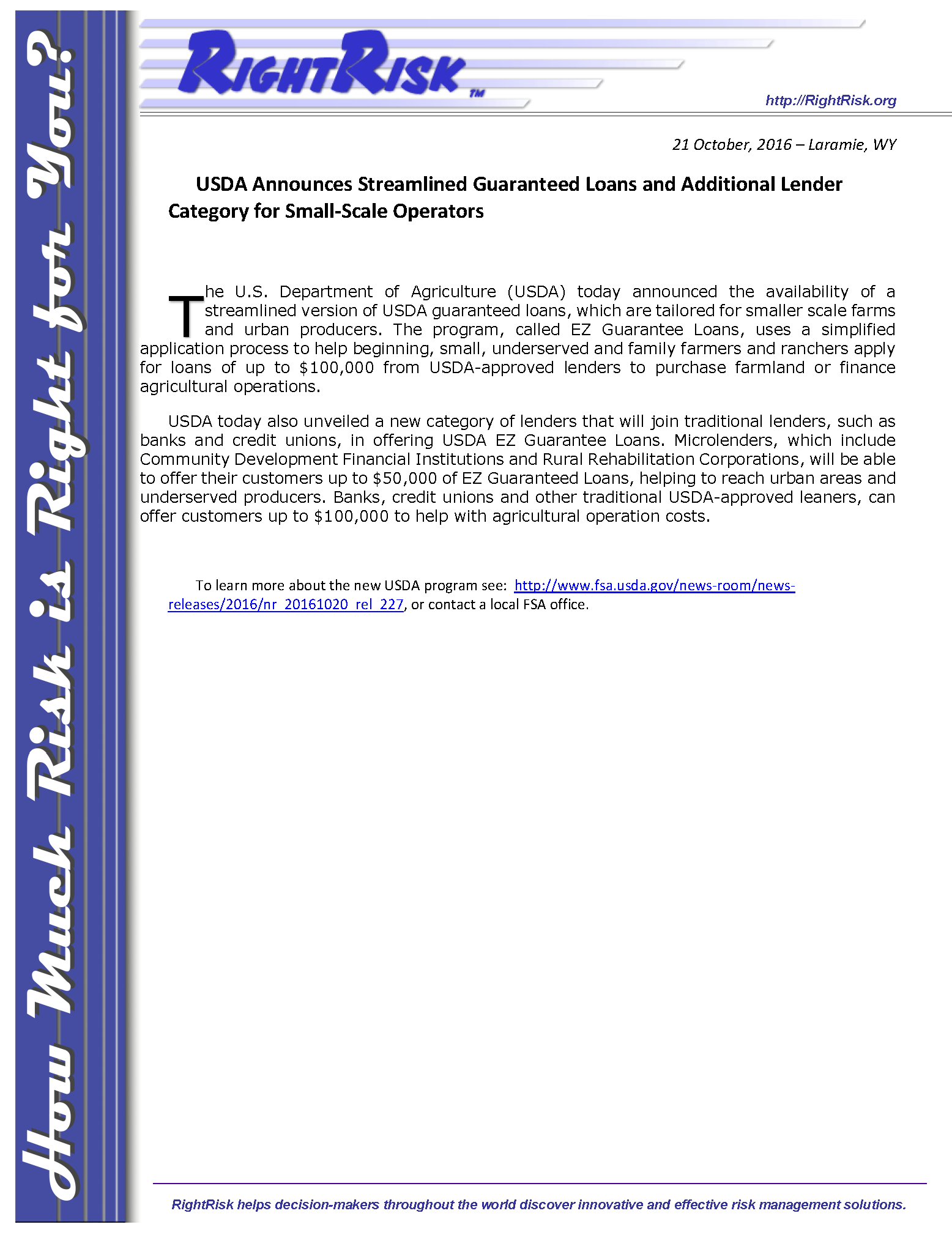
The U.S. Department of Agriculture (USDA) today announced the availability of a streamlined version of USDA guaranteed loans, which are tailored for smaller scale farms and urban producers. The program, called EZ Guarantee Loans, uses a simplified application process to help beginning, small, underserved and family farmers and ranchers apply for loans of up to $100,000 from USDA-approved lenders to purchase farmland or finance agricultural operations.
To subscribe/unsubscribe, send email to information@RightRisk.org with subject line “Subscribe/Unsubscribe RightRisk News”
The Multi-Temporal Risk Analyzer (MTRA) Tool was designed to provide economic analysis of multi-year management strategies and decisions involving risk. Examples include investment decisions, changes in production practices, adding and subtracting enterprises, and other decisions that involve multiple years to come to fruition or a multi-year commitment in order to see a positive economic return.
The MTRA tool is unique in that it is specifically designed to analyze risk and uncertainty over a number of years. This is usually accomplished for these types of investment decisions or decisions involving significant management changes by adjusting the time value of money (i.e. interest rate) to include risk or by using conservative estimates for expected returns to account for uncertainty. However, in many cases, these are difficult tasks to accomplish with accuracy or appropriately given the true nature of the uncertainty.
The MTRA tool allows the user to input the decision or proposed change in a partial budget template, where expected positive inflows (increased returns and/or decreased costs) are netted-out against expected negative outflows (decreased returns and/or additional costs). These individual inflows and outflows can be turned on and off over the course of 20 years to reflect long term expectations.